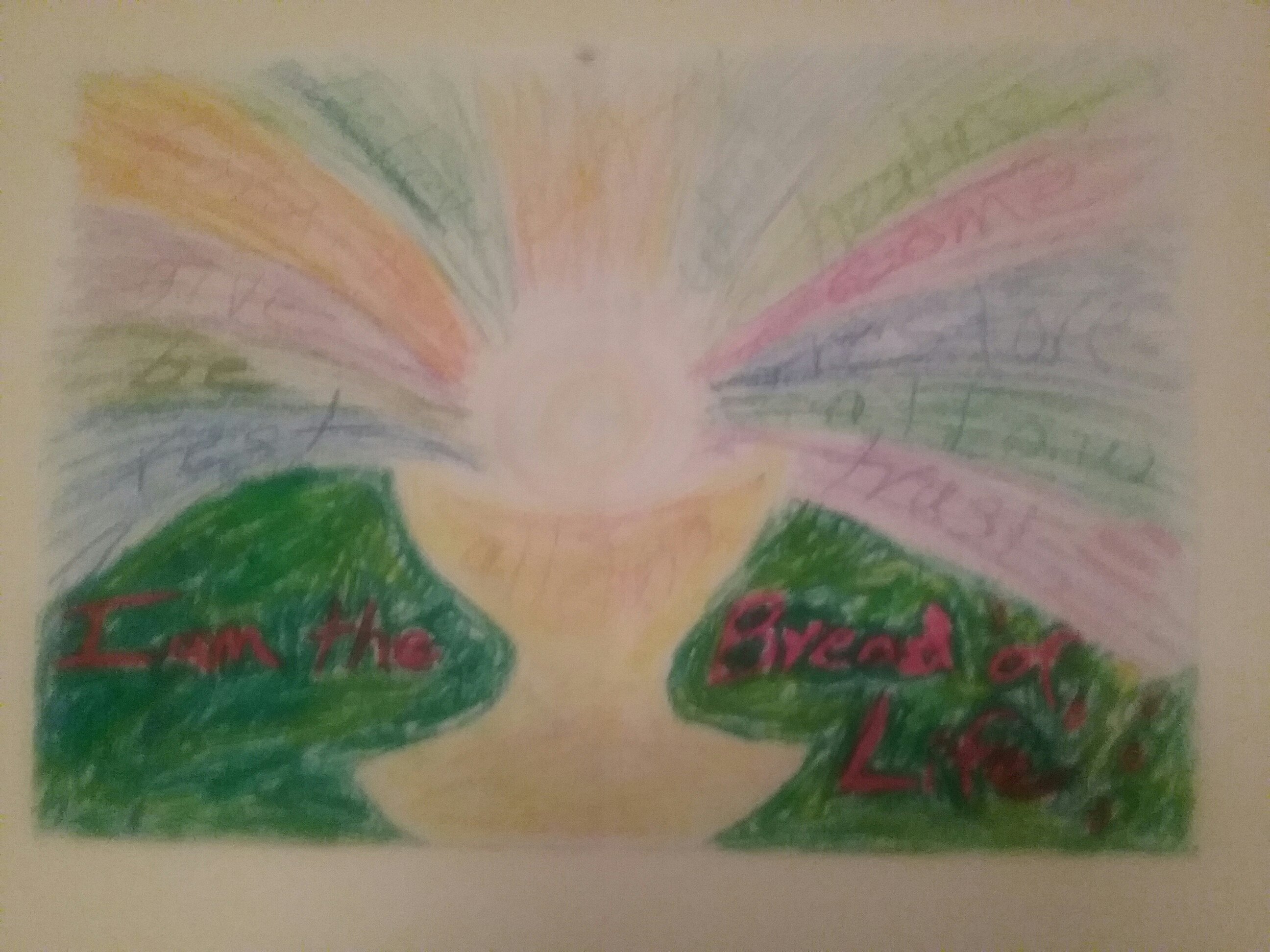
[My drawn meditation from a couple months ago on God feeding us]
All roads lead to Jean Vanier… at least in my life, in the past year.
Jean Vanier is a Catholic theologian who founded L’Arche, an organization of communities in which people with learning disabilities and their assistants live together. I’m blessed to volunteer two days a week at L’Arche London, where I truly just spend time with the folks there. I get to sing, dance, do puzzles, chat, take walks, just “waste time together” with residents. It’s a powerful experience in many ways, and challenges me to feel life to a different rhythm.
One of my favorite memories so far of this “year in God’s time” is attending a performance of “Jack and the Beanstalk” that was put on by a theatre company (connected with L’Arche) for people with and without learning disabilities. It was a night of celebration, basically one long dance party for all in attendance with about four 20 minute segments of “Jack” in there. I got to see my friends absolutely shine in their roles- my favorite moment was probably a four minute dance solo by a man who has a fantastic routine to a Billy Ocean song. Lucky for me, I get to dance to it with him just about every Friday. But seeing him center stage, with everyone cheering him on, was a moment of overwhelming joy for me.
Jean Vanier is not just a name behind an organization. He is a man with a profound sense of what it means that Jesus welcomes us in our poverty, whatever form that poverty takes. L’Arche is not heaven; it is not a “perfect” community where conflict is absent and life is a constant celebration. But it is a community that shows that everyone, all of us, have special gifts as well as vulnerabilities. It’s our vulnerabilities that allow God and one another in, to love us, and to be loved by us.
When I say “all roads lead to Jean,” I’m not just talking about my placement at L’Arche- I’ve been soaking up Henri Nouwen, and of course he spent a lot of time at L’Arche Daybreak, in Canada. L’Arche shaped him profoundly. And as a community here at St Anselm, we’ve been reading some excerpts from Jean Vanier’s books. There’s one poem in particular, from his book “Drawn into the Mystery of Jesus,” that has been in my head for the past two months. I want to share it here because I think it rings so true in its simple profundity.
To become holy
We human beings are a mixture
of the presence of God and the absence of God,
of light and darkness,
truth and chaos,
goodness and evil,
openness and closedness.
No human being in himself or herself is holy or pure.
We become holy only through the holiness of God.
By ourselves we cannot bridge the gap that separates
the finite from the Infinite.
God reaches out to us and we become holy
as we welcome God who comes to us.
This implies that we gradually become emptied
of the darkness and selfishness in us,
and liberated from the walls around our hearts
that separate us from God, from others and from our deepest self.
This holiness is not something we can achieve; it is given.
It is not reserved for a few strong-willed people,
for austere seekers of God,
for those who have an official role in the Church,
or for those who preach and do advanced theological studies.
It is not reserved for those who are well-known mystics
or for those who do wonderful things for the poor.
Holiness is for all those who are poor enough to welcome Jesus.
It is for people living ordinary lives and who feel lonely.
It is for all those who are old, sick, hospitalized or out of work,
who open their hearts in trust to Jesus
and cry out for his healing love.
“Come, Lord Jesus, come!”
—————————————-
Since my last blog post, I’ve experienced many things here, from a retreat on Life in the Holy Spirit to my discovery (with the help of a friend!) of a Catholic church I really like, from a weeklong Ignatian silent retreat to attending the enthronement of a Coptic Orthodox bishop. One line of this Jean Vanier poem that I have been drawn into more and more is this:
“Holiness is for all those who are poor enough to welcome Jesus.”
My faith is not something I can define or achieve for myself, and I am not at the center of it. My faith is about realizing my poverty, whatever lack or fear I am experiencing at this moment, and inviting Jesus in. Not pretending the struggle is gone, not trying to extinguish it by myself, but just dropping my net into the water- saying “come, Lord Jesus, come!”- and trusting him with the rest.
I hope this poem, “To become holy,” touched you as well. I’ve been mulling it over at this point for two months, and I am still finding its meaning afresh day after day.
We’re getting ready for Christmas here, which for us means traveling to Hautcombe Abbey to be with the Chemin Neuf Community there. We have some members of Chemin Neuf living with us here at Lambeth, both to provide chaplaincy support to the Archbishop, as well as to lead and guide our community. After Hautcombe, I’ll be having some adventures in Germany and Sweden for a holiday break before returning here in January.
This is my first time being away from home for Christmas, and also my first time being “on the go” so much around this time of year. I think about Mary and Joseph, who welcomed Jesus into their poverty and instability. God comes to us even when the world says there is no room for him. My prayer for this time of year is Jean Vanier’s prayer: that we might see our poverty, whatever it may be, not as a barrier to God, but as the place where we can let him in to love us. God bless you all this Christmas.
 Sing a New Song
” we welcome God who comes to us.
This implies that we gradually become emptied
of the darkness and selfishness in us,
and liberated from the walls around our hearts
that separate us from God, from others and from our deepest self.”
Truer words I cannot imagine! Thank you, Gabi, for sharing Vanier’s insight and wisdom! Blessings to you in this holy season!
LikeLike