A Prayer for Decentering

“Come to me, all you that are weary and are carrying heavy burdens, and I will give you rest.

Take my yoke upon you, and learn from me; for I am gentle and humble in heart, and you will find rest for your souls.

For my yoke is easy, and my burden is light.” -Matthew 11: 28-30

Today’s gospel reading may seem far-removed from the current awakening of consciousness around the racism and white supremacy in which the US is rooted. How often I have heard these words from Matthew in a comforting light, when what I need right now is not comfort.

This morning, I hear something new. I hear Jesus’ prayer for decentering. As he leans into his relationship with his Father in the preceding verses (“All things have been handed over to me by my Father; and no one knows the Son except the Father…”), he reveals the relational dimension of reality from which the burden of white supremacy is cut off.

Jesus invites us neither to self-flagellation, nor into white savior complex. Both of these continue to center on whiteness as they assume an ability to self-justify. There is no self-justification in following Christ.

These words of Jesus offer a new heart (see Ezekiel 36:26: “A new heart I will give you, and a new spirit I will put within you; and I will remove from your body the heart of stone and give you a heart of flesh.”) They offer us participation in God’s gentle, humble heart by decentering from our privileged nest, our locus of power that oppresses. This is the decentered heart, the heart as God created it. This is the heart in relationship, neither ignoring nor glorifying pain, but opening steadily to it.

As I make my way through Richard Rohr’s Breathing Underwater on twelve-step spirituality and the gospel, I am struck by Step 7. We must ask God to remove our addiction to bigotry:

Humbly asked [God] to remove our shortcomings.

Decentering our hearts is God’s work, not ours. We of course must be active participants, but we cannot direct it. It is relational; it is humbling; it is gentle in the places we are addicted to pain, and painful in the places we are addicted to comfort.

May we take up the yoke of Christ.

A few days’ stream of conscious musings

Yesterday as I prepared to officiate the kindergarten graduation for the little boy I’ve been tutoring these past few months, I was struck by the strangeness of this year:

It began with large doses of coffee and nervous energy as I subbed in for a local high school music teacher (on maternity leave) while working at a dry cleaners. I did not feel qualified for this job, but somehow (like many of the things I’ve ended up doing in these three years since graduating college) I survived, learning most from my mistakes.

I never imagined I’d have the chance (thanks to the Forum for Theological Exploration) to travel and explore sacred music-making around the country before retreating home in the midst of Covid.

And now this five-year-old boy, one of my greatest teachers: he is teaching me to be flexible (or at least try), to forgive, to share. I guess I needed to go back to kindergarten. And what learning has this year’s “school of life” brought? Something I’m not quite sure why I believe but I think I do:

Love, like energy, is neither created nor destroyed. It is discovered, shared, transformed.

When we pray, we are joining in the love that already exists. The truest path between creatures, or creature and Creator, is this love that just Is. This love is Being. This love is Truth. This love is breath, the ineffable “I am” that even the deepest, spirit-suffocating structures cannot snuff out.

I have failed badly at understanding this. I have refused love and love’s truth; I have preferred to hide.

Since my good friend Val passed away a year ago, I am brought back day in and day out to a story she told me. Amidst a painful moment in her battle with cancer, between sleeping and waking, she received these words:

You have to let the love in.

Every day now, I pray that I might listen to this Voice, too.

I am torn up about the racism and white supremacy that binds and blinds our country, torn up too by my neglect to let this truth into my consciousness for so long. Torn up by the pain that slowly starts to seep in; torn up by the pain of our human family I cannot even begin to fathom. Lord, have mercy.

We have to let the love in.

Watching a friend’s wedding live-streamed today and reflecting on the reading from Song of Songs Chapter 2: “Arise, my love…come with me. Lo! The winter is past; the rains are over and gone…” I was reminded of a setting of this text I haven’t heard in years.

We hear here of the New Jerusalem, a vision of the city without any walls, where joy will never cease. A place where the human family can live and flourish. This is the reason I sing. This is the reason why I continue to have hope, despite the many walls I have built in my heart and my life. I believe that this good vision, this good work that God has begun, will be brought to completion.

The Rain is Over and Gone

Come, Holy Spirit

fire

12-Step Spirituality in this time of Tragic Awakening

We white people need a change of heart.

As I watch and read the horrific news of the murder of George Floyd this past week, I am reminded of my recent trip to Minneapolis. This March, I met the Visitation Sisters, who have been called out of their convent to make a home in a Minneapolis neighborhood. Whenever the doorbell rings, they answer to Jesus.

The most moving part of the day I spent at their urban monastery was meeting their eldest member, Sister Mary Margaret. Though into her nineties, Sr. Mary Margaret leads a 12-step group for overcoming addiction to racism and white supremacy. This is work she commits to for the rest of her life.

As I learn more about 12-step spirituality through Richard Rohr’s book Breathing Underwater, it makes incredible sense to frame my racism as an addiction. From what little I understand of 12-step spirituality so far, I realize it is a journey. It requires recognition of failure to begin; realizing I have failed to manage or eliminate this addiction on my own. So I must turn to a Higher Power. And what better day than Pentecost Sunday to reflect on the ability for the Holy Spirit to make us new?

I do not mean to suggest that being born again can in any decisive moment turn one “non-racist.” I do mean to draw resonance with Sr. Mary Margaret’s knowledge that the rest of her life will be spent cycling through the twelve steps, surrendering her white supremacy to her Higher Power and asking to be transformed by the grace of God.

A reading for Pentecost Sunday

John 20:19-22, NRSV

“When it was evening on that day, the first day of the week, and the doors of the house where the disciples had met were locked for fear of the Jews, Jesus came and stood among them and said, ‘Peace be with you.’

After he had said this, he showed them his hands and his side. Then the disciples rejoiced when they saw the Lord.

Jesus said to them again, ‘Peace be with you. As the Father has sent me, so I send you.’ When he had said this, he breathed on them and said to them, ‘Receive the Holy Spirit.'”

We white people need a change of heart. We need to recognize the presence of Jesus among us by grieving the immense and constant loss of life in the communities of our black brothers and sisters.

We need to act, not from a place of fullness, but from a place of emptiness.

We do not have the answers. Clearly we do not know the way. We must submit, surrender, to be born again. To die to our heart of stone and beg God for a heart of flesh.

Right now this means grief, exasperation, allowing our hearts to be broken by the truth. Jesus is among us, standing with those oppressed and terrorized and killed, bearing in his body their trauma. Jesus is among us, those addicted to systems of white supremacy and racism, begging us to leave this heavy burden and repent.

The first step is failure and powerlessness. The second step is coming to believe that a Higher Power can change us. The third step is surrender to this Power.

Here is my adaptation of the Step Three Prayer for this moment (or era):

God, I offer myself to Thee to build with me and to do with me as Thou wilt.

Relieve me of the bondage of white supremacy and racism, of my ignorance and ego, that I may better do Thy will.

Take away my complicity with the structures that make it so that your people cannot breathe– that freedom from these may bear witness to those I would love of Thy power, Thy love, and Thy Way of life.

May I do Thy will always!

(I also think this prayer could and perhaps should be imagined collectively.)

Come, Holy Spirit. Come.


“Hymns to the Silence”

Here’s a page out of my pilgrimage journal, from my time at Holy Cross Monastery in West Park, NY:

“Hymns to the Silence” by Van Morrison
hymns to the silence

“I want to go in the countryside

Oh sit by the clear, cool, crystal water

Get my spirit, way back to the feeling 

Deep in my soul, I want to feel 

Oh so close to the One… 

And that’s why I keep on singing baby

My hymns to the silence” 


I experience this Van Morrison song as a dialogue with God, a yearning for communion. Sure, maybe the object of his affection is a woman he refers to here as “baby,” but I have no qualms hearing this 10 minute track as a prayer. Knowing what mystical union feels like, the rest of life spent remembering that precious taste becomes a string of “hymns to the silence.” We know deeply that God abides with us– we abide in God– but it is the passion and beauty of our human condition to long for this knowledge in an evermore experiential way. As Van Morrison sings, “I want to feel oh so close to the One.” 


I’m at Holy Cross Monastery in West Park, New York, along the Hudson. My musical experiences in this first 36 hour period have been fueled by this Van Morrison track and the chanted offices of the monastic community here. After Matins (morning prayer) and a silent breakfast, I ventured down the snowy hill to the bank of the Hudson. “Oh sit by the clear, cool, crystal water,” Van Morrison crooned in my ear as I giddily reached the overlook just above the water. The sun illuminated purple clouds in the distance as sheets of ice floated by. 


As I make my way through Thomas Merton’s classic No Man is an Island and attend the five daily prayer services with the brothers, I am struck by the stability of the Benedictine spirituality here. Unlike other religious orders where movement from one community house or job placement to another is typical, Benedictines commit not just to a way of life but generally to a particular place. They are rooted in their daily prayers, cycling through the same psalms and scriptures week after week, year after year. Their care for their common home and grounds (and often guests!) is a major part of their spirituality. 


Here at Holy Cross, this stability is palpable. Returning from a walk along the main road this afternoon, I rounded the corner into the monastery driveway and was hit by the feeling of home and welcome. It is the tangible presence of prayer soaking in these grounds for over a hundred years. 


This constant presence of prayer illuminates my exploration of No Man is an Island. Merton describes a spirituality grounded more deeply than the ups and downs of emotion. It’s a mature faith of accepting oneself, weaknesses and all, and remaining unattached to the results of our efforts. It is a spirit of equanimity, of seeking the divine purpose in all of life without confusing our interpretation for God’s interpretation. The balance of work, prayer and rest in the Benedictine lifestyle seems to me conducive for such even-keeled relating. 


Just when things are cohering, in pops Van Morrison with his passionate longing. “Oh my dear sweet love, it’s a long, long journey / long, long journey back home.” This hymn to the silence meanders in stillness at times, but also finds sticking points in passion. As a non-Benedictine, I must confess that this song helps me understand the desire and intent that illuminate the monastic lifestyle. 


All of creation is invested in singing these hymns to the silence until the silence overtakes and there is no need for the song. It is always a back and forth between sound and silence. The grass, the wind, the bells tolling time for prayer…the sunlight streaming into the room for noonday prayer. I just wanted to sit there in the stillness of the illumination, in the stillness of that hymn to the silence


Before my friend Val passed away last June, she gave me a book about the healing power of sound. Val had battled cancer for 14 years, and she was interested in exploring more with sound therapy. She had already had profound experiences with chant, but I know she was keen to try more. 


I’m sad I couldn’t bring more of that into her life, but I see that wish of hers as a final benediction upon my life. She helped me find my mission of bearing witness to the giftedness of all things, through contemplative practice of sound and silence. I know that Val’s generous spirit, in equanimity with the ups and downs of life, is with me. 


In that book that Val gave, the first story I remember was about a community of monks in France who got very sick and fatigued for no apparent reason. Finally, a doctor discovered it was because they had stopped singing. This chanted sound permeating their way of life for centuries had supported them. When they stopped singing and merely began speaking the prayers, their effort to conserve energy backfired. 


I feel that palpable energy of chant here. I close my eyes and feel the chapel fill with the unified resonance of the brothers’ voices. 


It is a different type of listening that I am on this pilgrimage to discover. The world of western classical music in which I grew up is, technically speaking, based on tension and release. The sense of pitch relationships (tonality) that makes this music tick is the creation of desire and either the fulfillment or frustration of that desire. 


Chanted traditions present a different musical world where the emotional experiences of tension and release do not hold as much power. Yes, there is a sense of wanting to return to a particular resting point, but the relationships between pitches are freer, less hierarchically structured. There is not as much of a teleological goal as in the closing of a phrase by Mozart or Beethoven. 


Here I am, shaped by this western classical sense of passion, but wanting to experience Merton’s equanimity. What to do. Ah, Van Morrison. In his simultaneously peaceful and passionate expression, I find resonance. He reminds me that this is all a hymn to the silence. 

Wait (but do not wait alone)

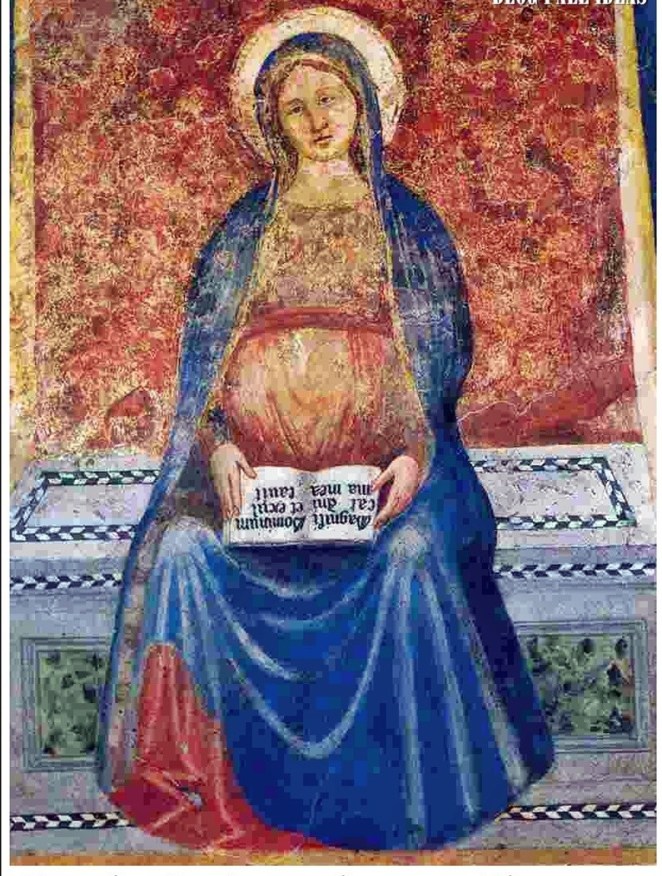
Mother Mary expecting

This stunning image of Mother Mary expecting comes from a church in Vicenza, Italy

I wrote this reflection for a livestream service meditating on the place of waiting we inhabit in this time of Covid-19.


Wait, but do not wait alone:


Wait with Noah, who knows not when the waters will subside,

Wait with Noah, who watches for the dove to return a single green branch. 

Wait, but do not wait alone.


Wait with the people of Israel who wander, lost in desert lands.

Wait with the people of Israel who are yet found each day among God’s presence, the cloud and the fiery pillar.

Wait, but do not wait alone.  


Wait with Job, who is battered by storm after unending storm.

Wait with Job, who still says:

“I know that my Redeemer lives, and that at the last my Redeemer will stand upon the earth…

Then in my flesh shall I see God.” (Job 19:25)

Wait, but do not wait alone.


Wait with Isaiah, whose people stumble in darkness, whose land is desolate.

Wait with Isaiah, who yet who cries out, “The people who walked in darkness have seen a great light.” (Isaiah 9:2)

Wait, but do not wait alone.


Wait with Zechariah, whose tongue is silenced, whose speech is cut off.

Wait with Zechariah, who yet knows that his baby boy will be filled with the Holy Spirit.

Wait, but do not wait alone.


Wait with Mary, who carries the Word of God in her secret, inmost being.

Wait with Mary, who looks for the fulfillment of all that has been promised.

Wait, but do not wait alone.


Wait, but do not wait alone:

Wait with all around the world who watch and pray,

Brothers and Sisters, Beloved of the same God

Who waits with us.

Pilgrimage in place

This pilgrimage has taken an unexpected turn.

After a beautiful array of time spent between monastic communities, friends and family, I arrived at Newark International Airport the evening of Monday, March 9.

I should have foreseen that I was arriving just as coronavirus was taking hold here, but I arrived anyway…naive, hopeful, ready to jump into my new space at General Theological Seminary and my worship arts internship at The Church of the Village.

It soon became clear that this temporary home would become a more permanent Home. It would be more than just a campsite from which I trekked around Manhattan and visited different churches and community groups.

In a strange way, the anticipated European leg of my pilgrimage (I was hoping to travel to Taize, followed by the Northumbria and Iona communities) had always seemed far-off, more possibility than impending reality. Strangely, I do not feel too disappointed to cancel or postpone it. I am supposed to be here now, on this rainy day in Chelsea.

I’ve fallen off the edge of the blogging world, as seems to happen whenever I commit to blogging on the go. I have to face the facts: I don’t travel blog. I travel letter-write and phone call, but I just don’t do mass communication from the road.

But landing here, I’m no longer on the road. I’ve been called off the road onto this detour of creating a space of prayer and creativity in this white-walled room that I slowly want to fill with poetry.

This is the next part of my pilgrimage, a part I never could have foreseen but I feel God is unraveling with me. It’s a pilgrimage of finding my “community of one” in which I am never alone. I’ve experienced such rich hospitality from all who hosted me since late January. I lived a plethora of precious lifestyles with different communities of the heart. I was continually struck by the diversity of daily devotions I practiced with my host families and communities: prayer, gardening, preparing food together, singing, meditating, walking, baby holding, kitty holding, playing fetch. Now it’s time for this inspiration to become flesh in my own life…to take up devotional practices in this time “set apart” for isolation.

I am beyond blessed by the ways that Church of the Village is providing for me emotionally, physically and spirituality. My room is filling with books and implements of worship on loan. Neither party in this internship could have foreseen that this would be a crash course in livestreaming contemplative services.

In such a time of crisis (*time of choice; time of turning), there is so much possibility…we are truly thrust into this time of creativity, unknowing, real grappling with our mortality. I do not mean to romanticize the suffering that we are undergoing globally, but to assert that this is truly a time of both/and…great loss and great possibility, I believe.

Accompanied by Joni Mitchell (who herself used to wake up to Chelsea mornings), Rublev’s icon of the Community of the Trinity, the friends and family who surround me virtually with their love, and all those who watch and wait (check out an upcoming post on “waiting”), I ask for openness toward God’s spirit moving here.


Lost and Found

This is the first post of my pilgrimage of listening. I’m spending this week in preparation for the trip, reflecting on where I am beginning. I will be off the grid for some of my travels but hope to blog as the Spirit moves. 


“Stop looking for me and let me find you.”

I was sitting in front of a window in Pelussin, France (pictured above) when I heard these words in prayer. They took me by surprise: I thought I was supposed to be the one seeking God.

I don’t wish to enter a dualistic frame wherein “seeking” and “letting oneself be found” are mutually exclusive. My experience leads me to believe that both effort and grace play their roles in the spiritual life.

You’ve got to live your religion,

Deep inside, when you try

For the kingdom on high

By His grace

(Van Morrison, “By His Grace”)

The dance of effort and grace is the reality of our beautiful human calling. We exist in the dynamic energy of this “both and.” When the prodigal son returns home, of course it is not his journey that earns him a place in his father’s house; he was “found” all along in his father’s heart. But his steps, taken out of hunger, bring the few twigs which allow the fire of grace to ignite.

Back to the small village of Pelussin, where I was taken aback by the instruction to stop looking. I had spent the previous four months serving in the kitchen and general house team at Hautecombe Abbey. I was coming to realize it was not “chez moi,” but I desperately wanted to follow the will of God. And I thought that for this year, that entailed living and praying with the Chemin Neuf Community as I discerned whether I might be called to religious life or ordination.

This is where I feel a turn from the eye to the ear helps me understand this call to “stop looking.” And to do this, I can’t help but call on audio ecologist Gordon Hempton. In his interview with Krista Tippett, he talks about the power of sound to reveal to us where we are. Deeper than the eye can see, sound grounds us in space, its vibrations connecting us to our surroundings.

Listening, says Hempton, is not about waiting to hear a particular sound. It is about presence. It thrives in equanimity. We are indoctrinated from a young age in particular hierarchies of sound, told what is important versus what to tune out. But Hempton advocates a different approach, full of welcome and free of judgment.

Instead of us naming and assigning value to the sounds, the sounds tell us where we are. 

When I left France to “let God find me,” it was wrapped in a sense that already I am found. This realization was at once a big leap of faith and an inevitable culmination of all I had heard. It was Jesus breaking bread with us at Emmaus, so tangibly there and so quickly gone.

Prosternez-vous, devant votre Roi, adorez-le de tout votre coeur.

Faites monter ver sa majeste des chants de gloire pour votre Roi des rois!

(my translation- poetic, not literal:)

Bow down in awe before your King, humbly adore him with all your heart.

Let praise arise, touch his majesty, with songs of glory to bless our King of kings!

(“Prosternez-Vous” by S. Fry)

As I have walked forward in letting God find me, this song continues to resonate throughout my heart. As Gordon Hempton feels when he hears a train whistle echo across the land, when I hear this song, I know where I am.

“Why were you looking for me?” Jesus asks Mary and Joseph in Luke 2:49: “Did you not know that I had to be in my Father’s house?”

My pilgrimage is not a pilgrimage of finding God through focused sight, but being found by God through listening. It is a call to bear witness to our essential “foundness.”

~~~~~~~~~~~~~~~~~~~~~~~~~~~~~~~~~~~~~~~~~~~~~~~~~~~~~~~~~~~~~~~~

I wonder when it was that the prodigal son realized his foundness. The story as a complete narrative reveals it to us outsiders, but for him, I wonder:

was it the embrace? the ring on his finger? the taste of feast on his tongue?

I wonder if he was just beginning to hear the silent song of being found that we are also in process of hearing our whole lives. Heaven, I’ll venture a guess, is this eternal foundness, and it is not until that death that we truly experience all that the return of the prodigal means. But we get these tasty sounds from time to time on our planetary pilgrimage.


And sometimes it hits you over the head

concussion

The day after I got a concussion from colliding with a bedframe, I got hit over the head with a realization about my long-pondered call to ministry. 

Growing up Roman Catholic, I’d felt called from an early age to serve God through music. My journey as a pianist and community musician landed me as a religious studies and piano major at Lawrence University, where I found my passion in making connections between spirituality and the arts. My growing sense of a call to ministry flourished as I connected with diverse peers over the sacredness of sounds and texts from various faith (and non-faith) traditions. Mysticism became my passion, academically and personally. 

As I prepared for my senior capstone on ecumenical Christian community, a powerful experience at Taize in France ignited a desire to live in community after college. I came to my “year in God’s time” with the Community of St Anselm in London harboring a hope that I would discern a call to ordained ministry within a denomination. I dreamed that my interior battle between my Catholic identity and my resonance with more progressive denominations could come to an end, and I would have the courage to break from the Roman rules and structures that I felt constrictive and antithetical to the gospel. 

Instead, I felt a deeper pull to reconciliation, to “living between” the traditions. There was no easy answer, just a lot of learning from life in religious community, and so I packed for my next adventure at Hautecombe Abbey in France. I was still in flux about my belonging to the Roman Catholic church, with all its flaws, all its hierarchy, and yet all its beauty and its mystical heritage. I would spend time in France living among celibate sisters whose Catholic vocation called them to ecumenism, and see if this was a life that drew me in. 

After a five month baptism-by-fire-French-immersion with the Chemin Neuf Community at the abbey, I realized it was time to come back Stateside. The death of a friend at the community had shocked me, the grief taking a toll on my mind, body and spirit. As much as I’d learned from the charismatic, ecumenically-minded community of Chemin Neuf, it was not “chez-moi,” and it was not the place for me to heal. I had been met with kindness and wisdom among my peers and mentors, but I lived with an uneasiness at the assimilation I witnessed as people seemed to adopt a common vocabulary and understanding of God and spirit. I wanted a contemplative spirituality. I wanted interfaith dialogue. I wanted a sense of evangelism that was not prescriptive, but a witnessing to the giftedness at the heart of all things. 

And so after I hit my head on the bedpost a few days ago, I realized that I am called to be a pastor. I am called to live and create at this intersection of spirituality and the arts that I began discovering at Lawrence. It’s in this way, through music and poetry and contemplative prayer, that I want to bear witness to the essential giftedness at the heart of all things. 

I used to think that a call to be a pastor put me in opposition to my Roman Catholic heritage, but now I see things differently. I am not called to be a priest, to administer the sacraments. I am called to reveal the sacramentality of daily living. I’m embraced by my mother church in the rites and rituals that underpin my understanding of reality. I just also believe that the veil of the temple was torn in two at the death of Christ, the membrane between “sacred” and “profane” ripped wide open. My space is calling attention to the sacredness of the everyday, which I can do pastorally– through music, chaplaincy, art, conversation, etc.– within the broader Catholic church, and beyond it.  

As I apply to divinity school, I am working on a five to six month pilgrimage of song that will prepare me experientially. I’m planning to travel the country and Western Europe, with grant money and my own funds, to explore people and communities who use sound in contemplative and community-building ways. I’ll be staying at Christian and Buddhist monasteries, visiting gospel choirs, chanting and who knows what else. My hope is for this pilgrimage to launch me into my studies.

I’ll close with the lyrics of a song by the dearly beloved Van Morrison:

And all I ever wanted was simply just to be me

All you ever need is the truth

And the truth will set you free

I’m not feelin’ it no more, I’m not feelin’ it anymore…

The false dichotomies taking up precious energy/ the fear that there’s no space at the Catholic table when I can just pull up a chair/ the judgments I make of others who I worry won’t accept me for bringing all I am, all my feminine energy to my vocation of “word becoming flesh”…

I’m not feelin’ it no more.


Mystics of Great Barrington

Children are often our primary mystical teachers.
IMG_0500
As I write this I am standing behind the counter at the cleaners. It’s a lazy Saturday morning and my coworker and I are waiting for our breakfast to be delivered. I’m reflecting on the little moments of joy here this week.
IMG_0498
A four year old came in a week ago with his grandfather and was enthralled with this bell. He began to ring it. “Stop that,” his grandfather gently said. “They must hear that all the time.”
Actually, never. We never hear the bell, I told the little boy. Please ring it.
He commenced an unending invocation of all that responds to the little bell’s voice—the room and our ears set vibrating to a pulsing rhythm.
Bells wake us up. They call us. They tell us to pay attention to the space we are in— they make us aware of that very space! The instrument becomes not just the small half sphere of metal but the resonance of the room– air particles vibrating, eardrums vibrating, all of us connected viscerally through the air that always connects us but now the connection is imminent, audible, witnessed.
IMG_0499
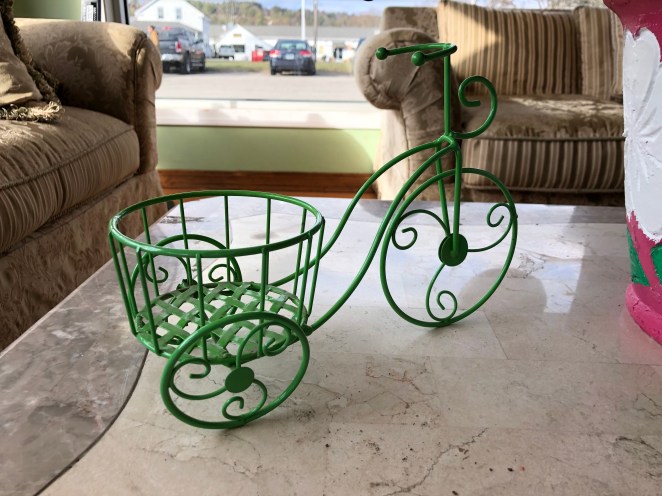
And then there is the little green bike. A two year old boy who has visited twice in the last week just loves to sit on the couch holding this little green bike. We even sang “The Wheels on the Bike (Bus)” semi-together. This little bike sits most days for hours untouched, while we handle credit cards and plastic bags and phone calls. But for 15 minutes when my little friend and his mom stop in, this small green bike gets loved. Time stops and it is simply beautiful.
Finally, my friend the credit card machine is a great teacher. She recently was moved on to a dial-up connection, which means she needs more time than usual. As I look at the screen during the 20 seconds it takes for each transaction, I am struck that the word that flashes across most is “receiving.”
She spends most of her time receiving. Would that we all consciously did so, little 20 second bursts of being open to the presence of God in our midst. “Slow down,” we might whisper to each other, like the child wishing to ring the bell or hold the bike.
“Slow down and let me receive this gift that is simply here.”

Like children

I ended up at my cousins’ house for a couple minutes the other day, looking for a pie server, of all things.

Seek and ye shall find…

But I suppose I hadn’t even know what I was looking for. Exhausted from work at school and then the dry cleaners, and on my way to the next activity, I didn’t know how badly I needed the healing touch of a three-year-old.

She met me with her wispy hair and ebullient smile in the driveway. She was eager to get back to her big brother, who was playing in the bushes.

“What’s he doing?” I asked.

“I dunno…COME ON!”

Her small but mighty words pointed me to Christ, and the mystery of the empty tomb.

“Where is he?” the disciples had wondered. Yes, Peter and John ran towards the emptiness of the tomb. But the overwhelming sense I get of the disciples (and often myself) post-Resurrection is the arrival of a great fear of the unknown.

“Unless you change and become like little children, you will never enter the kingdom of heaven,” Jesus himself says in Matthew 18:3. Through the revelation of holy wonder that came through my cousin’s eyes, I got a glimpse of this change of heart.

To be free to explore the unknown, knowing it’s in uncertainty that we meet and welcome Christ. To be unashamed of our limitations of knowledge and unafraid to be changed by the newness of life that meets us next. To desire being together in the breaking of the bread, though it never breaks exactly the same way twice.

“I don’t know…come on” is such a basic instinct in my small cousin but such a stretch for me. As I finish my job at the school tomorrow morning (hmm I am supposed to be grading right now but this seemed important), I approach my fear of the empty tomb. Would that this is the road to Emmaus, my cousins’ driveway, and that I can welcome the inevitably unexpected presence of Jesus in the stranger (or three year old) I didn’t know I needed.

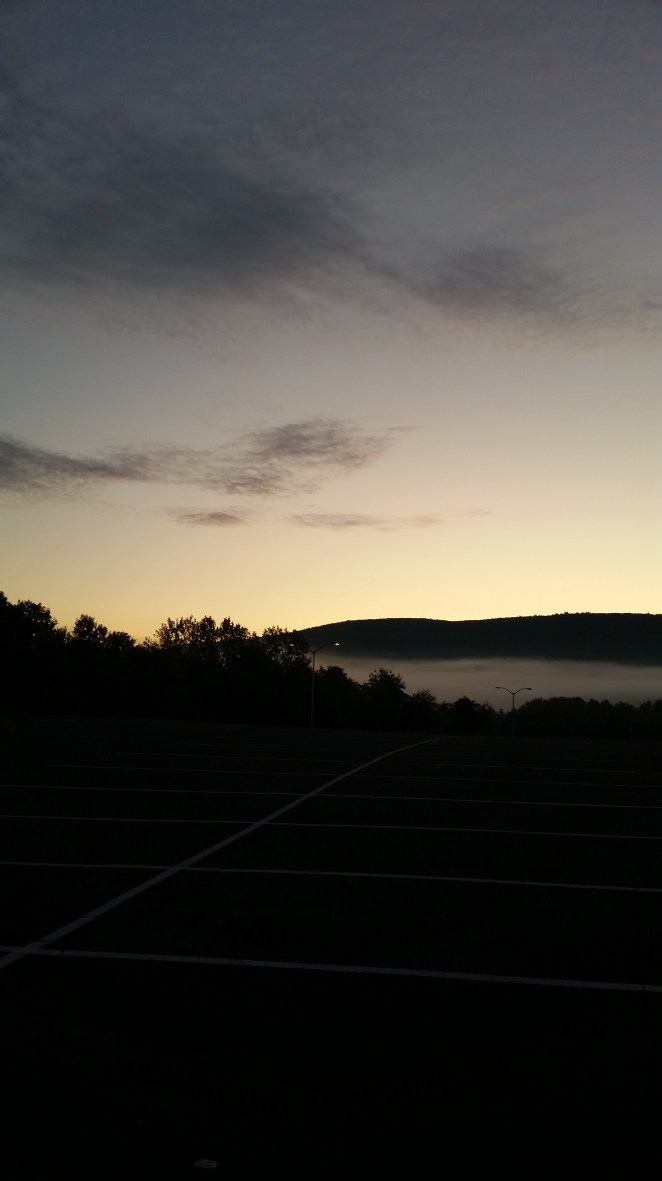
For now, I set out to enjoy my last foggy morning drive past the cows and wild turkeys, to the parking lot that also knows how to welcome each uncertain day. 20190926_064030