I recently brought a plant into my new apartment to add life and oxygen. The sales associate gave some basic cautions about watering, as did the Internet. Not minding the fact that I have barely kept a houseplant alive before, I charged ahead with minimal understanding of soil, light and water requirements. In my heart, though, I made a commitment to this plant: I will keep you alive. I will give you love. Please be a blessing in this space.
The ficus benjamina is also known as the “weeping fig” because it drops leaves when stressed. And to my surprise but probably not yours, drop they did. Brown leaves, yellow leaves, falling leaves.
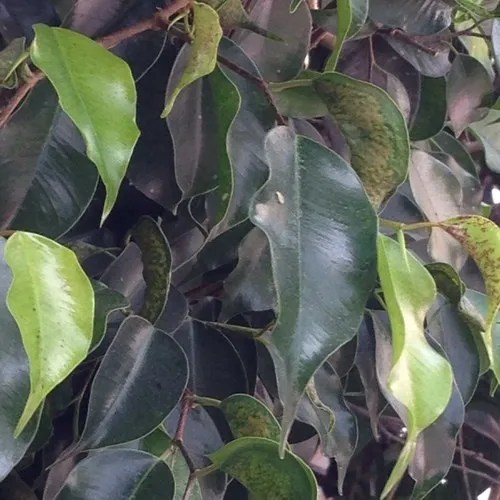
As hastily as I had made the decision to commit to this plant, I decided to rescue her. A new pot, new soil, new fertilizer, new location in my apartment. I heeded some Internet wisdom about what this ficus needs to thrive, but conveniently did not register this particular admonition until Operation Rescue was underway:
Change causes stress. It’s important to give the plant time to adapt to any changes. Even if it’s dropping leaves, don’t do anything drastic. Allow it to find equilibrium in its new space.
The greatest healer for my plant would be the gentle passage of time.
Years ago, a dear friend of mine told me about a vision she had while ill on the couch. Like arms, like branches of a great tree reaching inside to open her heart, a force of light. And the words: you have to let the love in.
I have held that moment in quiet awe ever since. I ruminate on those words like a koan: you have to let the love in.
Sometimes I try to let the love in by changing the soil, the pot, the water, and the light, all at once. So often I forget that letting the love in is a slower but much more secure and abiding process than my hasty interventions.
This is something I need to remember in my work as a chaplain, where I tend to others’ hearts as well as my own. These words by Jeff Foster have been speaking to me:
“Do not try to open your heart.
That would be a subtle movement of aggression toward your immediate embodied experience. Never tell a closed heart to open; it will shut more tightly to protect itself, feeling your resistance and disapproval. A heart unfurls only when conditions are right; your demand for openness invites closure. This is the supreme intelligence of the heart.
Instead, bow to the heart in its current state. If it’s closed, let it be closed; sanctify the closure. Make it safe; safe even to feel unsafe.
Trust that when the heart is ready, and not a moment before, it will open, like a flower in the warmth of the sun. There is no rush for the heart.
Trust the opening and the closing, too, the expansion and contraction; this is the heart’s way of breathing: safe, unsafe, safe, unsafe; the beautiful fragility of being human, and all held in the most perfect love.”
by Jeff Foster/ accessed at https://www.creativeselfcompassion.com/self-compassion-poetry
The ficus benjamina now sitting in abundant but indirect light has already been a blessing in my space. It reminds me to bow to the heart—my own heart, the heart of a hospice patient, the heart of anyone on my daily path—as is, in this present moment. Trust is the enduring way forward. The leaves of the heart will green when they have been readied, by unhurried attention and acceptance, to let the love in.
 Sing a New Song